
What is the Internal Rate of Return (IRR)?
The Internal Rate of Return (or "IRR") is a tool that informs potential investors about the profitability of a project. The IRR determines the rate at which the net present value of a project is zero. In other words, the IRR is the rate at which the discounted future cash flows generated by an investment (inflows and outflows) equal the initial cost of that investment.
The IRR allows investors to compare it with the rates of traditional banking products or the IRRs of other projects and determine whether the investment is worth considering.
How to interpret the IRR:
- If the IRR is higher than the cost of capital or the minimum expected rate of return, the investment is considered profitable, as it should generate returns higher than the cost of investing the money elsewhere.
- If the IRR is lower than the cost of capital, it means the investment would not be profitable compared to other investment opportunities.
How is the IRR calculated? The IRR is generally calculated from the expected cash flows of a project over several years. It is defined by the following equation:
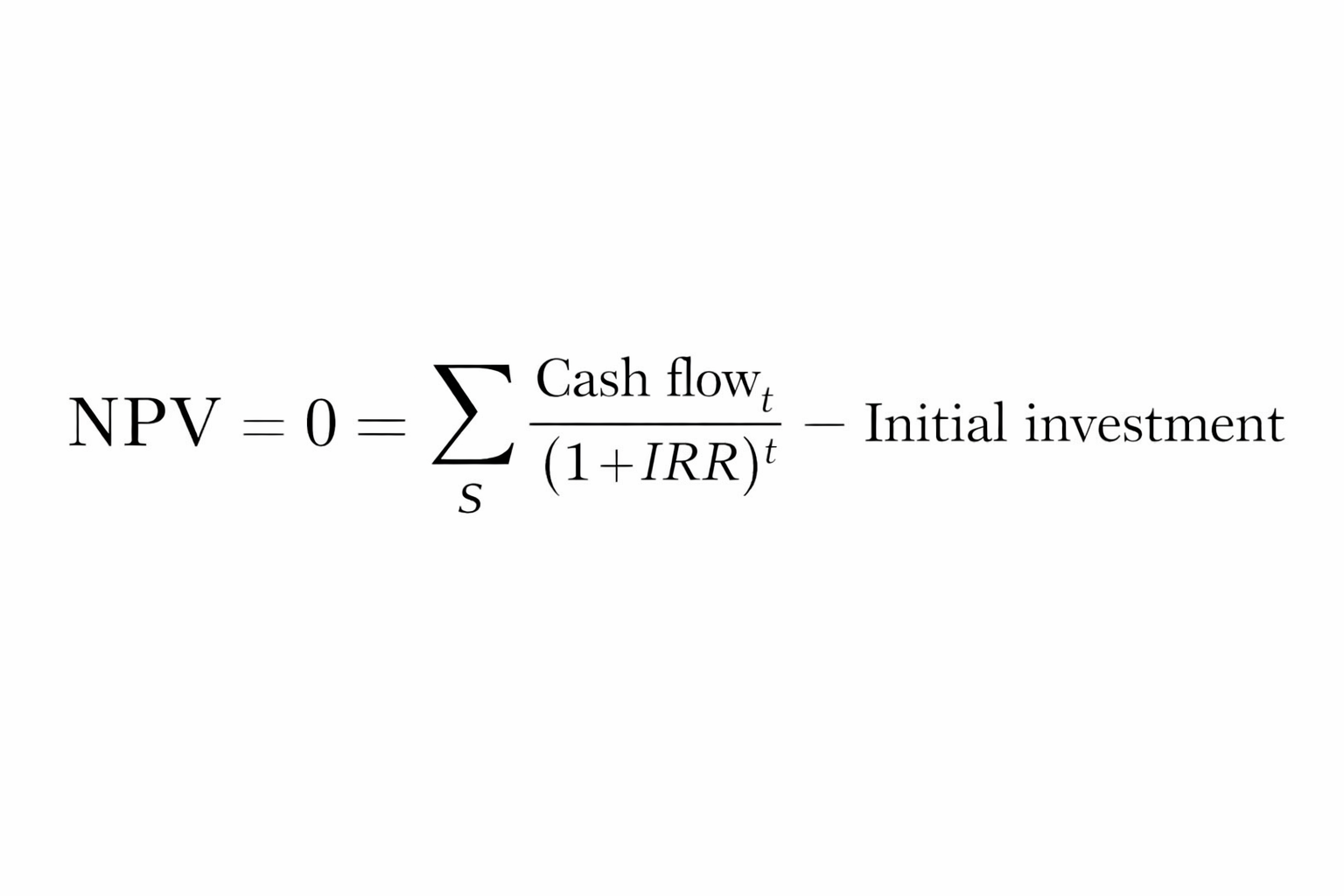
Where :
- t is the year or period,
- Cash flow t represents the cash flows in each period,
- IRR is the desired internal rate of return.