
The life stages of a project
Discover the complete journey of a renewable energy project, from its development to its dismantling and its impact on the environment.

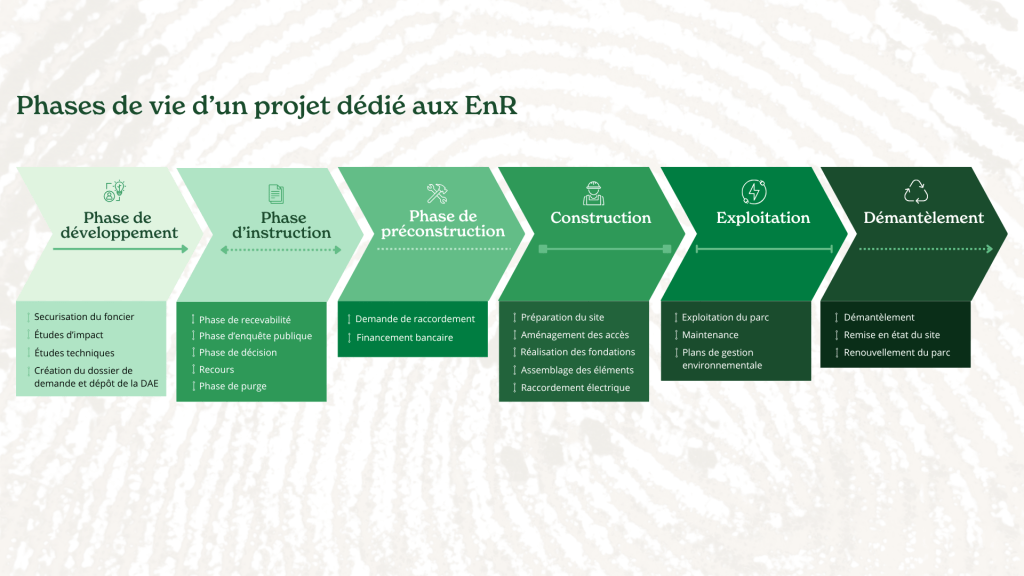
Today, we're taking you behind the scenes of a renewable energy project. Before any green electricity production, did you know that a project follows a strict timeline, governed by ecological, regulatory, technical, and financial requirements? From site identification to dismantling, including authorization applications, construction, and operation, it's a long process with multiple phases and numerous stakeholders involved. Step by step, let's discover the life of a sustainable project together!
Development
The first stage in the life of a project, development is the phase of prospecting, analysis and consultation. In other words, it is the moment when all the studies are carried out. Feasibility, securing land, commitments – financial, land and legal – planning, design development, choice of location, political and citizen discussions around the project… The project is in the process of being created!
💡 Good to know
During the development phase, the project leader must submit the DAE. What's that? This is the Environmental Authorization Application. Projects requiring it include installations classified for environmental protection (ICPE) and some of the Installations, Structures, Works and Activities subject to the Water Act (IOTA).
🤫 An article on this subject is coming soon… In the meantime, learn more by consulting the dedicated government website.
The instruction
The development phase gives way to the instruction, which begins once the project leader has submitted an authorization request to the competent examining service – most often, this is the departmental prefecture.
This much more administrative and legal part reviews every detail of the impact studies, the technical and financial capabilities of the project leader, as well as the design and characteristics of the project. This period allows us to check that everything is compliant, coherent and sustainable from an environmental, technical and social point of view.
During the investigation, we find in particular:
- the admissibility phase: this is when we ensure that the file is complete;
- the examination phase: the investigating department studies the file;
- the request for additional information: this allows, if necessary, to clarify gray areas and to propose modifications;
- the public inquiry phase: this officially allows citizens to express their views on the project;
- the decision phase: the prefect decides, after taking into account the opinions of his departments, whether or not to authorize the project.
💡 Good to know
Are you familiar with the purge phase?This pivotal moment in the authorization process means that, if no appeal has been filed within the allotted time, the authorization is said to be "purged" of all appeals.
Pre-construction
Once the project has been administratively authorized, the pre-construction phase can begin. It includes submitting applications for connection to the electricity grid to RTE or Enedis (the transmission and distribution network managers) – a process generally considered upstream during the development and instruction phases. This stage is accompanied by obtaining an electricity purchase tariff, structuring financing, and preparing the construction site. Everything is being done to prepare for the next phase, namely construction.
💡 Good to know
Construction sites must take the following requirements into account:
be carried out outside the nesting period of local bird species; the project leader is committed to protecting the surrounding biodiversity, under the supervision of the competent government services; temporary access roads created for the site are restored to their initial state once construction is completed, as are any existing roads that may have been damaged...
Construction
Development and instruction have passed. No appeals on the horizon? So, let's start building the project! As its name suggests, this is the moment when it comes to life, when work begins, and when we begin to glimpse the final result.
Construction includes 3 main stages.
- Development of access and platforms: This is the site preparation stage during which access roads are created, the platform locations are built, and excavation work is carried out to pour the foundations.
- Creation of the foundations: Regardless of the renewable energy infrastructure, this is a crucial stage ensuring the stability and sustainability of the project. As a guide, the foundations of an onshore wind turbine of more than 3 MW require approximately 600 to 800 m³ of concrete (Source).
- The arrival of the elements and their assembly: In a way, this is when the project becomes real! This transition allows us to move from theory to practice by seeing the work become concrete and operational. Once connected, the infrastructure goes through several testing phases with the grid manager before producing electricity.
💡 Good to know
Depending on the size of the project, the duration of this phase will inevitably vary, however it is often between 6 months and 1.5 years.
Operation
Just as eagerly awaited as construction, operation begins as soon as the park is commissioned. Managing electricity production, maintaining infrastructure—whether preventive (planned preventive actions to avoid outages) or curative (repairs following a malfunction or breakdown)—implementing environmental management plans—operation mobilizes teams on a daily basis, which is a real plus for the community where the park is located, which sees its economy boosted by job creation, the payment of local taxes, and possibly interest paid to citizens who participated through sustainable investment.
As a responsible investment platform dedicated to the energy and ecological transition, Enerfip offers you the opportunity to invest the amount of your choice in renewable energy production, energy efficiency, or sustainable mobility projects.
💡 Good to know
Depending on the project, the operation of a project can last up to 30 years.
Decommissioning
Often overlooked in blog articles, the decommissioning phase is nevertheless synonymous with the end of a project's life or, on the contrary, its renewal! Of course, the question of the project's future is discussed upstream with the community and the project leader to best anticipate possible scenarios. Will it be used for another project? Will the park be renewed?…
Regulatory requirements require the operator to dismantle the park and restore the land. If this option is chosen, workers will come to deconstruct and recycle/recover the materials. However, if the park is renewed, this is called repowering. This simply involves replacing the old installations with more efficient equipment that is better suited to new environmental and technological standards. This is the beginning of a new life for the project!
Now you have all the tools you need to better understand the challenges of the energy transition. So, what are you waiting for to take the plunge into responsible investing? If you are interested in this type of investment or have any questions on the subject, contact our Investor Relations team without further delay.


Our latest articles
.jpg)

.jpg)
.jpg)
Investor Relations
Please feel free to contact Enerfip's Investor Relations Department for assistance with your applications.


Lorem ipsum dolor sit amet, consectetur adipiscing elit. Suspendisse varius enim in eros elementum tristique. Duis cursus, mi quis viverra ornare, eros dolor interdum nulla, ut commodo diam libero vitae erat. Aenean faucibus nibh et justo cursus id rutrum lorem imperdiet. Nunc ut sem vitae risus tristique posuere.
Lorem ipsum dolor sit amet, consectetur adipiscing elit. Suspendisse varius enim in eros elementum tristique. Duis cursus, mi quis viverra ornare, eros dolor interdum nulla, ut commodo diam libero vitae erat. Aenean faucibus nibh et justo cursus id rutrum lorem imperdiet. Nunc ut sem vitae risus tristique posuere.